


Mechanical Vaping: A Complete Beginner's Guide
Mechanical Vaping Guide
Contents
1.0 Introduction
2.0 The Basic Rules
2.1 What should you look out for with the atomizer?
3.0 Batteries - what you need to know
3.1 Formulas
3.2 Voltage sag
1. Introduction
Mechanical vaping – it’s all about getting back to basics. When the first vape devices came onto the market, they were initially purely mechanical devices. Back then, understanding mechanical vaping was part of every vaper’s basic toolkit. These days, things are very different. You no longer have to juggle volts, ohms and amps – most devices handle all that automatically. What makes mechanical vaping so appealing, though, is that it’s arguably vaping in its purest form: no endless features and no electronic bells and whistles.
In this guide, you’ll find the key information you need to use mechanical devices safely and enjoy your vape.
2. The Basic Rules
When you use mechanical devices, you’re going without the electronic components that protect you from short circuits, deep discharge and overloading your batteries. That’s why it’s essential to follow a few rules for mechanical vaping and take the time to understand the topic properly.
Mech mods come in all shapes and sizes, from tube mods and box mods to pipe-style devices.
One essential feature that, unfortunately, not all mechanical devices have is vent holes. Vent holes allow pressure to escape out of the device if a battery vents. Don’t panic: this almost never happens, provided you stick to the basic rules of mechanical vaping. If the device doesn’t have any vent holes, in the worst case the pressure has nowhere to go, which can lead to an explosive venting event. In the event of a short circuit, the inside of the battery is overloaded instantly and, in some circumstances, the battery releases all its energy through a chemical reaction in a very short time. If you’ve bought or been given a device without vent holes, we strongly advise against using it.
That brings us to rule number one - vent holes are a must.
2.1 What should you look out for with the atomizer?
Rule number two is very simple – we don’t use stock-coil atomizers on mechanical mods.
In most cases, stock-coil atomizers don’t have an adjustable positive pin. Because the negative and positive contacts sit very close together at the 510 pin, the central positive pin can sometimes have a little play. The chances are very low, but it can still accidentally cause a short circuit. It can also happen that a new coil head is faulty and causes a short circuit too, and that’s something we definitely want to avoid.

Almost all rebuildable atomizers have an adjustable positive pin that you can tighten if needed so it stays firmly in place. Here you need to make sure, first, that it has no play and, second, that it protrudes far enough from the 510 connector to prevent an accidental short circuit. The following images show roughly what this should look like.
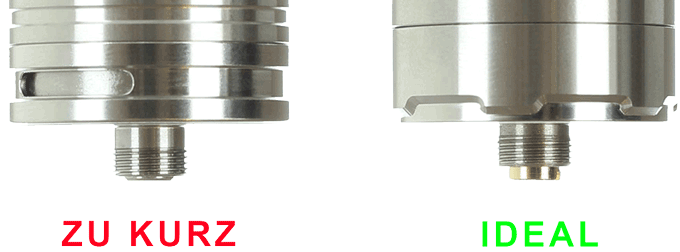
Rule number three - We NEVER build coils on a mechanical device.
Why?
- you have no way to monitor a potential short circuit
- you have no control while dry-burning - you could even burn through the wire
- you have no resistance readout
3. Batteries - what you need to know
Rule number four - Make absolutely sure you don’t overload your batteries!
There are countless different 18350, 18550, 18650, 20700, 21700 and 26650 batteries on the market. They differ mainly in their capacity (mAh) and in the continuous discharge rating and pulse rating (amps) they are designed for.
3.1 Formulas
Because of voltage sag under load, we generally use 3.7V as our reference. It’s also important that you use the battery’s continuous discharge rating in the formulas and NOT the pulse rating. This guide and these formulas apply exclusively to mechanical devices that take ONE battery.
The following formulas can be extremely helpful:
This formula lets you calculate the lowest safe build for your battery.
Volts / amps = ohms
As an example, let’s take a battery with a 30A continuous discharge rating. With a full battery, we assume a voltage of 3.7V under load, which gives us the following calculation:
3.7V / 30A = 0.12 Ω
Now we know we can build down to 0.12 Ω and still use the device safely. Anything below that is no longer on the safe side, and we clearly advise against it.
Want to know what resistance you need to vape at a specific wattage?
Volts * Volts / watts = ohms
Again, we start with a full battery, so 3.7V, and want to know what kind of build we need for 60 watts.
3.7V * 3.7V / 60W = 0.22 Ω
So we need a resistance of 0.22 Ω to get 60 watts of power with a full battery. But be careful! If, for example, you want 70W, you need a resistance of 0.19 Ω; for 80W, 0.17 Ω. As you can see, it’s absolutely essential to build very accurately if you want an exact result.
You’ve already built your coil, or the resistance came out differently than planned, and you want to calculate whether your battery can still handle the load?
Volts / ohms = amps
Let’s say we’ve already built our atomizer to a resistance of 0.25 Ω and we know our battery is rated up to 30A.
3.7V / 0.25 Ω = 14.8A
As you can see, in this example there’s still plenty of headroom before you reach the battery’s limit. So you’re on the safe side.
3.2 Voltage sag
You might assume that these formulas always give perfectly exact results. Unfortunately, that’s not quite true, because:
The higher the load on the battery, the more the voltage (volts) sags.
Working this out exactly isn’t really worth it, because the internal resistance of batteries changes after every charge cycle. So you would have to measure every single battery from scratch every time, adjust the formulas accordingly and rebuild your coil. That’s why, in our formulas, we use a loaded voltage of 3.7V instead of 4.2V.
IMPORTANT - We strongly advise against using cheap hardware or clones in general. It’s best to buy your batteries and mechanical devices from a trusted Swiss vape shop and get detailed advice.
About me - After three years of vaping and more than two years working in sales at the Zurich and Horgen stores, it was high time for a change of scenery, and somehow I ended up in the endless depths of the Dampfi office. There, among other things, I discovered an unexpected love of writing, so in future I’ll be bringing you plenty of informative, pointless, funny, helpful or silly posts. Requests, suggestions and criticism are very welcome and can be sent to [email protected].